
The most common question we hear from men walking into the academy is some version of: “Am I too old for this?” Usually it comes from someone in his thirties or forties who has not done any sport since school, sits at a desk all day and has watched a few jiu-jitsu clips online.
The short answer is no. Jiu-jitsu is one of the few combat sports people start in middle age and keep doing for decades. Here is what to expect, and how to make the first few months go well.
Why BJJ suits older beginners
- Technique beats strength and youth. A 45-year-old who understands position will regularly handle a fit 22-year-old who doesn’t. That never stops being satisfying.
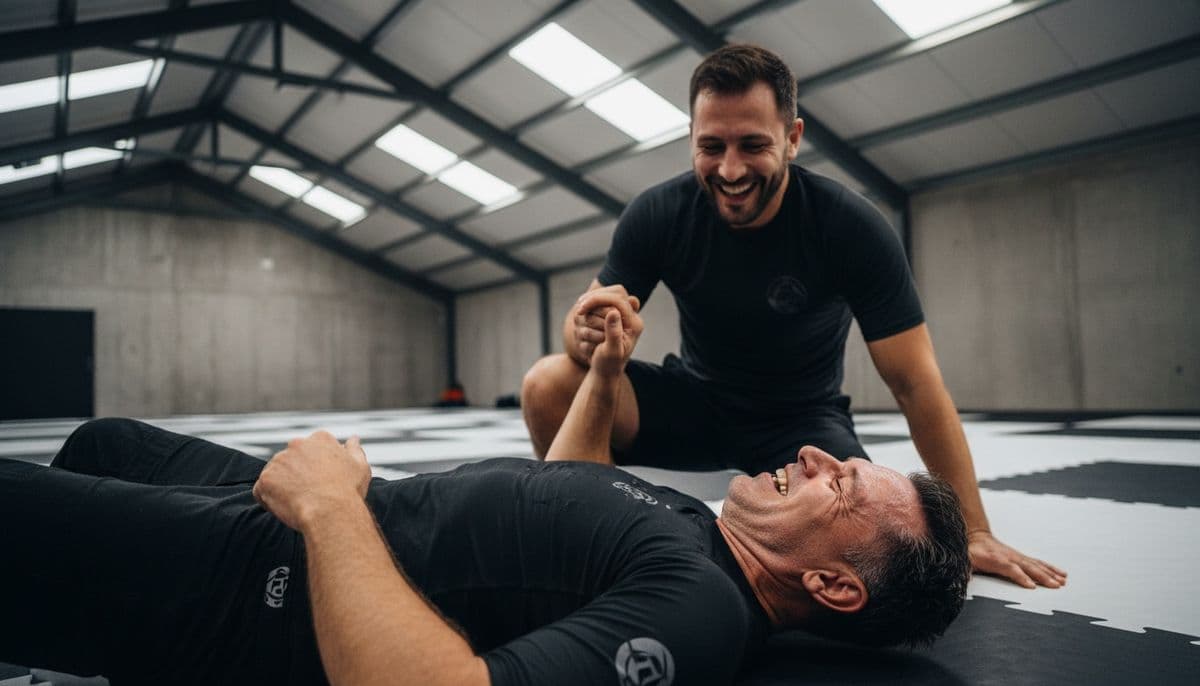
- You control the intensity. Nobody is punching you in the head. Sparring is about position and submissions, and you tap (a quick tap on your partner or the mat) to stop at any moment. Rolls can be gentle or hard, and you and your partner decide.
- It keeps your brain busy. BJJ is often called physical chess. You will spend the drive home thinking about the one position you could not escape, and that is half the fun.
- The room is full of people like you. Fathers, tradesmen, office workers, nurses, police officers. Your training partners become some of your best mates.
Your first three months
Weeks one to four. Everything feels new. You will learn how to fall safely, how to move on the ground and a handful of basic positions. You will get tired faster than you expect, mostly because you are tense. That passes.
Months two and three. Things start to click. You recognise positions, you know what you are trying to do even if it doesn’t work yet, and you start to have rolls where you survive comfortably. This is the point where most people get hooked.
Beyond. Belts in jiu-jitsu take a while (a black belt is typically a decade’s work), which means every stripe means something. Most adults train two or three times a week.
Training smart when you are not 20
- Leave your ego at the door. You will be tapped by people half your size, including women and teenagers. It is meant to happen. The people who last are the ones who laugh about it and ask how they did it.
- Tap early, tap often. Joint locks and chokes are safe because you tap before anything is damaged. Tapping is not losing; it is how you get to train tomorrow.
- Tell the coach about old injuries. Bad back, dodgy knee, shoulder surgery: we will help you work around it. You record your health answers when you join, and the coach sees what they need.
- Recovery counts. Sleep, water and a rest day between your first sessions make a bigger difference at 45 than at 25. Our yin yoga class on Thursday evenings is included in the membership and is excellent for hips and shoulders.
“I need to get fit first”
You don’t. Getting fit is what the classes are for. Fundamentals classes start with a warm-up that anyone can do, and you work at your own pace. If you want extra conditioning, the strength gym at The Farm is included in the Adults membership from age 18.
How to start at SWBJJ
There are no free sessions at SWBJJ: every class is coached and paid for. Starting is simple. Tell us a little about you and a coach will call, WhatsApp or email to suggest the right first class and answer your questions. Adults train from 16, and the Adults membership is £98 a month with no joining fee and no contract beyond the month. It covers jiu-jitsu in the gi and no-gi, open mats, Thai boxing, yin yoga and, from 18, the strength gym.
We are at Unit T, Blatchford Road, Horsham RH13 5QR, inside The Farm, with a car park at the unit and a café that looks onto the mat. Prefer to talk first? Call 01403 864444.